"So, naturalists observe, a flea has smaller fleas that on him prey; and these have smaller still to bite ’em; and so proceed ad infinitum."
- Jonathan Swift
Showing posts with label turtle. Show all posts

January 18, 2022

Sulcascaris sulcata

Shellfish such as oysters, mussels, and whelks are popular fares among seafood lovers, but we are not the only ones with a taste for those molluscs. Despite being heavily-armoured, many of the animals that we consider as "shellfish" are also food for a variety of larger marine animals. But their status as prey to these larger animals also make them attractive intermediate hosts for a wide range of parasites, which use these shellfish as vehicles to reach their final hosts. And sometimes humans end up being the unintended destination.

Anisakidae is a family of nematode worms commonly found in some seafood, and it is responsible for anisakiasis - a type of seafood-borne illness. While their usual hosts are mainly marine mammals, when anisakid nematodes get in humans, they nevertheless try to burrow through the stomach or intestinal wall, causing a great deal of pain. Additionally, their tissue and protein secretions may also cause a severe allergic reaction, including acute onset anaphylaxis.

Most studies on anisakids and anisakiasis focus on the genera Anisakis and Pseudoterranova which are often found in fish. But there are many other lesser-known genera and species in the Anisakidae family. Sulcascaris sulcata is one such species and unlike other anisakid nematodes which use marine mammals or birds as their final hosts, Sulcascaris infects a marine reptile - specifically the loggerhead sea turtle - as its final host.
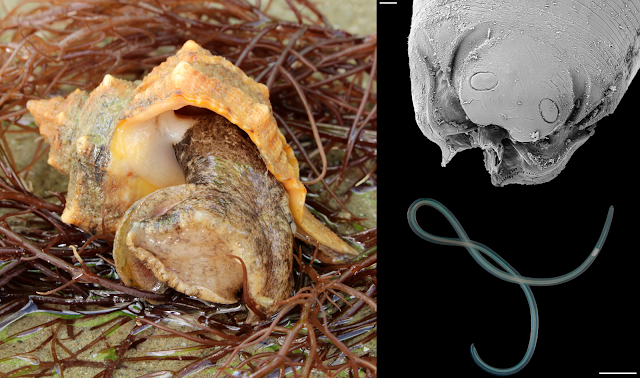
Left: Photo of a Purple-dye Murex by Holger Krisp, used under the Creative Commons (CC BY 3.0) license
Right: (top) SEM close-up photo of Sulcascaris larva's head, (bottom) a fourth-stage Sulcascaris larva  
(Photo of the nematode from Fig. 2 and Fig 4. of the paper)

Larvae of Sulcascaris have recently been reported from scallops and mussels - which raises some concerns since both are popular shellfish that are often eaten only lightly cooked or not at all. A recently published study adds another shellfish to that list - the purple dye murex, Bolinus brandaris. These large predatory snails are so-called because they used to be harvested to obtain a special type of purple dye. But in addition to their historic use in the textile industry, they are also commonly eaten in many parts of the Mediterranean.

A group of researchers in Italy obtained a haul of purple murex from fishermen on the coast of Baia Domizia, Italy, and brought the snails back to their laboratory to dissect them for parasites. Upon detailed examinations of the snails' organs, they found that 9 out of the 56 snails they obtained were infected with Sulcascaris larvae. However, infection intensity was very low, with most of the infected snails being parasitised by just a single nematode larva. These larval worms measured between one to five centimetres long, and were mostly lodged at the base of the snail's proboscis, with a few others found in the mantle cavity - the fleshy bag in a mollusc's body which houses its gills and other organs. 

Because of where those parasites are located in the snails, they can easily get overlooked during routine sanitary inspections, which only involve examining the outer appearance of the snail. The reason why those worms were mostly situated in those parts of the snail's anatomy might be due to their infection pathway. When the eggs of Sulcascaris are released from the turtle host, they settle onto the seafloor where they hatch into larval stages that lie in wait for an encounter with an unlucky murex. As the predatory sea snail moves across the sea floor, searching for prey with its proboscis, those larvae are sucked in via the inhalant current which transport them right into the snail's proboscis and mantle cavity.

Sea turtles with their strong beak and jaws can crack into these tasty snails which are off-limits to other animals, but it also means they end up with Sulcascaris in their gut. While this and previous studies on Sulcasacris have found that most shellfish carried only one or two individual nematodes, a turtle can eat a lot of shellfish, and over time may end up accumulating dozens or even hundreds of those worms in their stomach. When present in large numbers, these nematodes may cause ulcerous gastritis in sea turtles. But aside from that, not as much is known about this worm compared with its more famous, mammal-dwelling relatives, such as Anisakis.

So what does this mean for people who love eating shellfish? Based on prior experiments, it seems that Sulcasacaris can only infect sea turtles, so it is unlikely to become a zoonotic infection if it ends up being ingested by humans. Also, as mentioned above, when they are present, it's only one or two worms in each shellfish, and since purple murex are usually eaten after being cooked, this would kill the worm in the process. So the health risks presented by Sulcasacaris to any seafood consumers are relatively minimal.

However, like other anisakid worms, their tissue and secreted proteins may still potentially cause allergic reactions in some people, even after cooking. But not much is known about that possibility. The researchers suggested that at the very least, commercial fishermen should avoid harvesting snails from areas with sea turtles, since they are likely to be infected with Sulcascaris. This could be a win-win situation for both turtles and people - the turtles get to keep their feeding grounds to themselves, and seafood lovers can safely enjoy some worm-free sea snails. 

As the consumption of fish and other seafood increases around the world, there is a greater need for more studies on the wide variety of parasites that are found in seafood, along with people who have the skills and expertise to identify them - so we can continue to enjoy seafood without unintentionally barging into the life cycle of a parasite (and suffer its associating consequences).

Reference:
Santoro, M., Palomba, M., & Modica, M. V. (2022). Larvae of Sulcascaris sulcata (Nematoda: Anisakidae), a parasite of sea turtles, infect the edible purple dye murex Bolinus brandaris in the Tyrrhenian Sea. Food Control 132: 108547.

April 15, 2017

Amphiorchis sp.

Sea turtles have a lot of different parasites infecting them - in a previous post I wrote about a recently published study on a parasitic copepod that eats sea turtle skin. But as well as external parasites, turtles are also infected by a range of internal parasites, many of which are digenean flukes, but the ones that cause the most harm are the blood flukes. While most parasitic flukes that infect turtles live in the intestine and cause relatively little harm unless they occur in large numbers, blood flukes, as their name indicates, live in the circulatory system.

Top: shell of the worm snail Thylaeodus rugulosus,
Bottom: cercaria of Amphiorchis sp.
Photo from Fig. 1. of the paper
Infection by these blood flukes can cause a range of disease symptoms, but by far the main source of grief to their reptilian host comes from the eggs they lay in the hundreds and thousands. These microscopic eggs get circulated in the turtle's blood vessels and many of them become lodged in various parts of the turtle's body where they can cause damage to the surrounding tissue as they triggered the body's immune response. Infected turtles often have internal lesions throughout their tissue and various organs.

But how these flukes get into the turtles in the first place has long been a mystery. Like other digenean trematode flukes, blood flukes require some kind of invertebrate host - usually a snail - in which they undergo asexual/clonal reproduction to produce free-swimming larval stages call cercariae (which is the stage that infects the turtle). But there are many different species of snails in the sea, which species is/are the one(s) pumping out those turtle parasites? It is like looking for a needle in a haystack in a bigger haystack which is the size of an iceberg.

Recently, a group of very sick loggerhead turtles presented an opportunity to find out more about the life-cycle of these blood flukes. At the Sea Turtle Rescue Centre (ARCA del Mar) (which was where the study described in the previous post took place). Some juvenile turtles were exhibiting symptoms that matched those caused by blood fluke infections and it seems that they were infected by a species of fluke from the Amphiorchis genus. So how were they getting infected? The water supply at the facility is semi-closed and pre-treated to remove any contaminants - so the turtles must be getting infected by cercariae which were coming from inside the facility.

The silver lining to all this was that it was a great opportunity to work out what Amphiorchis is using as a first host to produce clonal larvae. As mentioned above, for most species of flukes, this is usually a snail, and there is only one species of snail living in the facility - worm snails that were encrusting on pipes that delivered water to the facility. Dissection of some specimens confirmed that those snails were filled with the asexual stages of Amphiorchis and thus the source of infection.

The worm snail is a peculiar family of snails call Vermetidae. Unlike other snails, this family of tube-shaped molluscs have evolved to live like tube worms or barnacles by cementing themselves to a hard surface, and casting out a sticky mucus net to haul in microalga, zooplankton, or anything else that gets caught in its snot web (see this video here). This might explain why some sea turtles end up getting such a heavy infections out in the wild. Worm snails are abundant on reefs, or form part of reefs themselves, and sea turtles often hang out around such habitats.

Furthermore, the turtle's shell also happens to be a good surfaces for these snail to stick to - while few encrusting snails in themselves usually wouldn't cause much problem to a sea turtle, if they are infected with Amphiorchis or other blood flukes, these snails get converted into little parasite factories that pumps out a stream of turtle-infecting larvae - and what better host for those tiny, short-lived cercariae to infect than the turtle that the host snail is already encrusted on?

Reference:
Cribb, T. H., Crespo-Picazo, J. L., Cutmore, S. C., Stacy, B. A., Chapman, P. A., & García-Párraga, D. (2016). Elucidation of the first definitively identified life cycle for a marine turtle blood fluke (Trematoda: Spirorchiidae) enables informed control. International Journal for Parasitology 47: 61-67.

March 25, 2017

Balaenophilus manatorum (revisited)

At some stage of their lives, parasites need to move from one host to another - some move around a lot throughout their lives, staying just briefly on a given host before moving onto another. While others only do it once during their larval stage - once they reach their host, they are there for life. Either way, they still need to make a perilous journey to their host.

Top right: newly hatched nauplii, Top left: Copedpodite V stage, Bottom: Adult female with eggs
Image composited from photos from Fig.1, 5, and 6. of the paper

This post is about study on Balaenophilus manatorum - a tiny parasitic copepod that lives on sea turtles. How does a tiny crustacean like that manage to find their way onto a turtle in the wide expanse of the sea? Do they jump on board when the turtle come into contact with each other, or can the larval stage swim on their own? Obviously they have managed to find a way because this copepod is very common among the juvenile loggerheads in the western Mediterranean, with over 80 percent of loggerhead turtles infected with B. manatorum. Given how small they are (the adult copepod is only about a millimetre long), it seems as if they would be barely a nuisance to their host. But when they occur in large numbers, they can be an serious menace.  And they seem to have a very particular taste. It was thought that B. manatorum feed mostly (if not exclusively) on sea turtle skin.

To find out more about how B. manatorum infect their hosts and what they feed on, a team of scientists did a series of studies on some B. manatorum which were removed from a batch of sea turtle hatchlings. These hatchlings were being reared at the Sea Turtle Rescue Centre (ARCA del Mar) - a rescue and rehabilitation for sea turtles in Spain. They came from a brood of eggs that was removed from a beach frequent by tourist to ensure their safety, but during their stay at the centre, many of them develop symptoms of infestation by B. manatorum, each of them infected with about 300 B. manatorum and one unlucky turtle was hosting over 1400 copepods. While removing the copepods from the turtles, the research team collected some of the egg-bearing female copepods that were on the turtles, and reared them until their eggs hatched into larvae for the further study.

In the feeding trials, the copepods were offered a menu selection consisting of: flakes from the baleen plates of a fin whale, fish skin (from a blue whiting), green alga, loggerhead turtle skin flakes (from some hatchlings that had succumbed to B. manatorum infestation). All those items were dyed with a stain to track if they get ingested. They confirmed that these copepod only ate turtle skin flakes and didn't touch the other items on the menu. Other species of Balaenophilus have been recorded from the baleen plates of whales, but B. manatorum feed exclusively on turtle skin. From the moment it is born, B. manatorum is equipped with mouthparts which are well-suited for scrapping flakes from hard flat surfaces, such as the skin of a turtle. So it is no wonder heavy infestations of B. manatorum can cause severe lesions and skin erosions in turtles, especially for the more vulnerable hatchlings

But B. manatorum still need to reach the turtle in the first place. When placed in a dish of seawater, newly hatched copepods (called nauplii) seemed rather helpless, only able to crawl around. But if they manage to survive to grow into the subsequent stages called copepodite, they will develop legs that would allow them to swim for a bit - just barely, and once they grow past a stage call Copepodite IV, they can swim well enough to reach another turtle on their own. It seems that this parasite relies mostly on the social behaviour of the turtle for transmission. Newly hatched B. manatorum nauplii cannot swim and would have to wait for the turtles to touch each other (for example during mating) to climb onboard another host (rather like how human lice are transmitted), whereas the copepodites and adults can just swim across if another turtle comes close enough

Therefore, these parasitic copepods may present as a kind of social cost to these turtles, since not only is a social communicable parasite, it can also be a sexually transmitted infection. For B. manatorum, their entire world really is found on the back of a turtle.

Domènech, F., Tomás, J., Crespo-Picazo, J. L., García-Párraga, D., Raga, J. A., & Aznar, F. J. (2017). To Swim or Not to Swim: Potential Transmission of Balaenophilus manatorum (Copepoda: Harpacticoida) in Marine Turtles. PloS One 12(1), e0170789.

October 1, 2010

October 1 - Placobdella papillifera

Closely related to a glossiphoniid leech we saw earlier, Placobdella papillifera is a pretty leech distributed in North American freshwater habitats. P. papillifera is a blood-feeder, feeding on turtles (and sometimes alligators!). This leech was found under a rock in Savannah River in South Carolina. There are two pictures shown here, one showing the papillae on the dorsal surface and one showing the smooth ventral region. This leech was large, filling out the entire bottom of a petri dish! (Click on the thumbnail to get a good look at its pretty papillae.)

Contributed by Jessica Light.

September 16, 2010

September 16 - Balaenophilus manatorum

Balaenophilus manatorum is an ectoparasitic parasite of sea turtles and possibly manatees as well. Recently, specimens of this parasite were obtained from stranded loggerheads on the Spanish coast. Gross morphological and SEM studies could not distinguish these copepods from others that had been found on sea turtles off of Japan and so, for the moment, have been classified as that species. The parasites can be incredibly dense -the authors of this paper note that thousands were found on individual juvenile turtles. Other parasitologists have speculated that this species is the same copepod that has also been found on manatees in the Caribbean. Thus, either this parasite is very much a generalist or there are cryptic species yet to be determined.

July 9, 2010

July 9 - Haemogregarina macrochelysi

If you are thinking about swimming in a southern pond make sure you don't let your feet dangle...they might get chomped by an alligator snapping turtle (Macrochelys temminckii) - one of the meanest creatures you can come across. Maybe they are mean because they're often covered with leeches sucking their blood - and sometimes those leeches can transmit blood parasites, such as today's parasite, Haemogregarina macrochelysi, a new species of hemogregarine (another distant relative of malaria, Babesia and Toxoplasma). The authors of the paper reported that every single alligator snapping turtle they sampled from seven different locations had these parasites.

Photo by Sam Telford, Jr., the primary author of the paper.

May 22, 2010

May 22 - Placobdella parasitica


Today's parasite, the leech Placobdella parasitica is an excellent parent. Not only can it perform both motherly and fatherly duties simultaneously (it's a hermaphrodite), it also takes good care of its young. These leeches spend most of their lives on turtles, particularly snapping turtles, where they will feed on the blood primarily around the leg pits and tail (where the turtle's formidable jaws can't reach them.) They brood their young on their ventral surface protecting them there until they are big enough to feed on their own, which sometimes means transporting them to their first meal. Despite the caring nature of the leeches post reproduction, the conception of those young is actually quite violent. Leeches will stab small spermatophores into each other in a process known as traumatic insemination. Yipes.

Photo by Mark Siddall.

February 18, 2010

February 18 - Gigantolina elongata


Gigantolina elongata belongs to a small group (as in only 8 species are known!) of parasitic worms known as amphilinids. Although some of these parasites infect fish, this species is found in freshwater turtles of Australia. The parasites are bright yellow in color and as many as 30 of the large (150+ mm) worms can be found in a single host. It is unclear exactly how the eggs of the worm are released in the water, but once they do, larvae hatch out and find a young crayfish where they penetrate the cuticle of their host by a complex process that involves both chemical digestion of the cuticle and sawing it open with tiny hooks. When turtles eat the crayfish, the young worms pentrate the turtle’s esophagus and make their way to the body cavity where they will grow and mature into adults.


Nominated by Klaus Rhode

January 20, 2010

January 20 - Neoechinorhynchus emyditoides


Neoechinorhynchus emyditoides is a species of acanthocephalan, or thorny-headed worm. These parasites often have very complex life cycles involving multiple trophic levels. The vertebrate host of this species is a turtle and, as the picture shows, a single turtle can have hundreds of worms – in some cases, more than 1000! - filling its intestine. The acanthocephalan eggs are expelled in the turtle’s feces and are eaten by ostracods, tiny crustaceans, where they develop into a stage called an acanthella. When fish eat the ostracods, the acanthella travel to the fish’s liver and await the fish’s ingestion by a turtle. There are 10 species in this genus and they are extremely difficult to tell apart. This photo likely contains a mix of both N. emyditoides and Neoechinorhynchus pseudemydis. The host in this case was a red-eared slider (Trachemys scripta) collected from Reelfoot Lake, Tennessee.

Nomination and photo by Mike Barger.