 This parasite can be baaaaad, to sheep - and to humans. Fasciola hepatica, or the common liver fluke, is a trematode parasite with a typical complex life cycle like so many that we have seen here before, involving snails that are common around pastures. Metacercariae are ingested by grazing animals and then they seek out liver tissue and feed for a month or two, causing anemia and other symptoms in the animal. Eventually, they mature into adults and settle down in the bile ducts and just churn out eggs - about half a million a day! Humans can become infected with this parasite through accidental ingestion of the metacercariae in water, on water plants, through contact with livestock and perhaps from ingesting raw liver from infected animals.
Showing posts with label livestock. Show all posts
Showing posts with label livestock. Show all posts
December 14, 2010
December 14 - Fasciola hepatica
This parasite can be baaaaad, to sheep - and to humans. Fasciola hepatica, or the common liver fluke, is a trematode parasite with a typical complex life cycle like so many that we have seen here before, involving snails that are common around pastures. Metacercariae are ingested by grazing animals and then they seek out liver tissue and feed for a month or two, causing anemia and other symptoms in the animal. Eventually, they mature into adults and settle down in the bile ducts and just churn out eggs - about half a million a day! Humans can become infected with this parasite through accidental ingestion of the metacercariae in water, on water plants, through contact with livestock and perhaps from ingesting raw liver from infected animals.

October 16, 2010
October 16 - Cochliomyia hominivorax
.jpg) The New World screwworm, Cochliomyia hominivorax, is a parasitic dipteran whose maggot larvae invade organs or tissues of living organisms in a type of infestation called myiasis. Attracted to wounds and sores, an adult C. hominivorax female deposits batches of 10 to 400 eggs onto the living tissue of warm-blooded vertebrates, even humans. Larvae feed and develop for 3 or 4 days and then drop off the host body to pupate in the soil, later becoming adult flies. Once prevalent throughout North America, this parasite was known for infesting livestock and causing major economic loss. Their damaging impact prompted the development of the Sterile Insect Technique (SIT) by Raymond Bushland and Edward Knipling in the 1950s. Male screwworm flies were sterilized by irradiation in the laboratory and released to mate with wild females. The females subsequently produced infertile eggs and over generations of sterile male release the population of C. hominivorax was greatly reduced. This control method was successful in eradicating the parasite from North America and much of Central America, leading former U.S. Secretary of Agriculture Orville Freeman to refer to the Sterile Insect Technique as "the greatest entomological achievement of [the 20th] century."
The New World screwworm, Cochliomyia hominivorax, is a parasitic dipteran whose maggot larvae invade organs or tissues of living organisms in a type of infestation called myiasis. Attracted to wounds and sores, an adult C. hominivorax female deposits batches of 10 to 400 eggs onto the living tissue of warm-blooded vertebrates, even humans. Larvae feed and develop for 3 or 4 days and then drop off the host body to pupate in the soil, later becoming adult flies. Once prevalent throughout North America, this parasite was known for infesting livestock and causing major economic loss. Their damaging impact prompted the development of the Sterile Insect Technique (SIT) by Raymond Bushland and Edward Knipling in the 1950s. Male screwworm flies were sterilized by irradiation in the laboratory and released to mate with wild females. The females subsequently produced infertile eggs and over generations of sterile male release the population of C. hominivorax was greatly reduced. This control method was successful in eradicating the parasite from North America and much of Central America, leading former U.S. Secretary of Agriculture Orville Freeman to refer to the Sterile Insect Technique as "the greatest entomological achievement of [the 20th] century."Contributed by Phil Scheibel.
September 20, 2010
September 20 - Neospora caninum
 Originally confused with Toxoplasma gondii, Neospora caninum is a coccidian parasite that alternates between cattle hosts where it forms cysts in their tissues and canines such as dogs and coyotes, though transplacental transmission has been demonstrated in both intermediate and determinant hosts. Although this parasite does not seem to infect humans, it is of interest because it can cause spontaneous abortions in livestock if they are infected (resulting in economic losses perhaps as much as $24 million in Texas alone) and has also been linked to neurological disorders in dogs. The parasite is found virtually everywhere in the world where there are canines and cattle.
Photo of N. caninum in calf brain by Steve Upton.
August 10, 2010
August 10 - Dicrocoelium dendriticum
 Dicrocoelium dendriticum, better known as the lancet fluke, is a species of fluke that lives in the liver of grazing mammals such as sheep. Like most flukes, it has a 3 host life-cycle, the adult worm living inside the sheep, lay eggs which are shed into the environment with the sheep's faeces. The first intermediate host for this parasite are terrestrial snails which become infected by accidentally ingesting the parasite's eggs. The parasite undergoes clonal replication inside the snail, producing hundreds of infective larvae which are then packaged into slime balls and extruded into the environment. For some reason, these slimeballs are eagerly gobbled up by ants which are the parasite's second intermediate host.
Now sheep are not known for including ants as a significant part of their diet, so how is D. dendriticum supposed to get itself into a sheep through an ant? It does that by taking control and setting its ant host up for a rendezvous every evening. Once infected, the ant begins to behave very oddly indeed. As dusk falls, it would crawl up a blade of grass until it reaches the tip, then firmly clamps itself into that position with its mandible for the entire evening. The infected ant would perform this peculiar routine every night, but as the sun rises, it would resume its usual activities - assuming that it has survived the evening and not been incidentally ingested by a hungry sheep. By inducing this peculiar behavioural pattern in the ant host, D. dendriticum brings itself (through the ant) within the vicinity of a grazing sheep, thus setting up an encounter which otherwise would not have occurred, allowing it to complete its seemingly obtruse life-cycle.
Check out the very funny cartoon version of this life cycle here.
Contributed by Tommy Leung and thanks to Craig Carlough (Lancaster, PA) for sending along the Oatmeal comic.
July 18, 2010
July 18 - Strongyloides westeri
 Poor babies - baby horses, that is. Strongyloides westeri is a nematode known as a threadworm that can make foals very sick by giving them very bad diarrhea, resulting in weakness, weight loss and poor growth. The adult worms reside in the small intestine and lay eggs that pass out in the feces. Horses can be infected by ingesting the larvae or if the larvae penetrate through their skin, however, one of the most common routes of infection is via the mother's milk, which is somewhat unusual among parasites. For this reason, veterinarians commonly recommend that mares be dewormed on the day that they give birth and that foals be dewormed several times in their first few weeks.
July 13, 2010
July 13 - Dioctophyma renale
 The aptly named Dioctophyma renale reaches maturity in the host’s kidneys. Also known as giant kidney worms, they are one of the largest nematodes capable of infecting humans-adult females grow to be over 100 cm long (they are also bright red and about 10 mm wide). Although they don’t feed on kidney tissue, they cause pressure necrosis (imagine a meter-long, centimeter wide worm living in your roughly computer mouse-sized kidney), turning the kidney into a non-functioning hollow shell. It has a cosmopolitan distribution and affects humans, several species of canids, horses and pigs, and uses annelids as intermediate hosts (fish can be paratenic hosts). Vertebrate hosts become infected by eating an infected intermediate or paratenic host or by drinking water in which they are swimming. Luckily, human infections are uncommon. On rare occasions, they become encysted in other organs (e.g. ovaries, uterus, urethra, mammary gland or subcutaneous tissue) or migrate through the digestive tract or abdominal cavity, making for an unpleasant finding during veterinary surgical procedures.
Contributed by Andrés Gómez.
Photo from this site.
June 29, 2010
June 29 - Gasterophilus intestinalis
 Growing up, I was an avid horseback rider and had both a horse and a pony. Today's parasite was always one of the things I dreaded about summer. Gasterophilus intestinalis, the horse botfly, is an annoying creature to horses and horse owners alike. The females are large and aggressive and pester the horses until they eventually alight and deposit small eggs that stick to the horse's hair like glue, most often on their legs. The eggs itch and so the horse licks and bites at it, eventually swallowing the eggs. The larvae then live out the fall and winter months in the stomach of the horse, which can make the horse lethargic and induce colic. In the spring, they are passed out in the feces, where they pupate and then emerge as new - annoying - flies. We would always try to prevent infection by scraping the eggs of the horses' legs using specially made rough sponge-like things - I spent hours doing that each summer!
The photo shows a very heavy infestation of botfly larvae in the stomach of a horse and comes from this site.
May 30, 2010
May 30 - Ascaris suum

Although most commonly found infecting pigs, Ascaris suum, a large roundworm nematode, can also infect humans. This species has the same lifecycle as Ascaris lumbricoides, and also like its cousin, has eggs that are extremely durable in the environment. Although they were long popular in biology classes as a large, easy-to-dissect representative of Nematoda, because the eggs are so resistant and easily spread, the represent a health risk and their use has largely been discontinued. You can virtually dissect one here.
May 19, 2010
May 19 - Pythium insidiosum

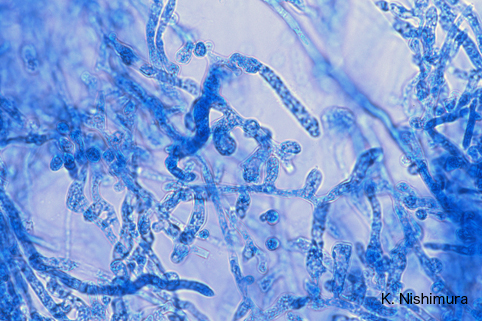
Oh man - this is a nasty one. I had a really hard time finding a photo that wasn't completely disgusting and opted for just a nice image of the simple fungi themselves. The parasite is Pythium insidiosum, a fungal parasite that causes a disease known as pythiosis in dogs and horses. It's a common parasite in warmer parts of the world including the American South, eastern Australia, and south America and primarily exists in swampy, standing water. Dogs can become infected in their GI tract from drinking tainted water and it can cause thickening of the tissues or granulated lumps. Horses more often have subcutaneous lesions of these fungi, which they get from standing in the swampy water. The damage to their legs, bellies, and chests can be quite gruesome and often the lesions will have bits of dead tissue in them with the somewhat amusing name of "klunkers."
The disease is apparently on the rise in the U.S. and is troublesome because many vets are not familiar with it. I found this website with some rather sad tales of beloved pets who have been lost to the disease.
The image is from this site.
April 28, 2010
April 28 - Melophagus ovinus

What do you call a fly that doesn't fly? In this case, you call it a sheep ked. Melophagus ovinus is a very common ectoparasite of sheep. The adults feed off the blood of the sheep, hiding easily in the wool. The females will give "birth" to well-developed larvae, which actually feed off "milk" that is secreted by specialized glands of their mother. They then pupate, cementing the pupal case to the wool. The pupal stage will last for about a month and this stage is unfortunately resistant to any insecticides, making keds difficult to eradicate if the population is firmly established. Keds are distressing to the sheep and as they attempt to itch them, they will rub off or thin out their wool. thus pose economic threats to shepherds who find themselves struck with these pesky insects.
April 11, 2010
April 11 - Taenia solium

Having a pork roast for Sunday dinner? Then, you probably don't want to think about today's parasite, Taenia solium, the pork tapeworm. Humans can acquire these worms by eating undercooked pork and if so, then the tapeworms mature into adults and take up residence in the intestine, where they can grow up to 7 meters long and will release eggs in shed proglottids. However, sometimes humans are infected after ingesting eggs directly, which means the human turns into the intermediate host. In these cases, cysticerci or bladder worms can infect other tissues, including the brain, producing a very serious and potentially even fatal disease and sometimes must be surgically removed. A recent study has suggested that humans have been hosts to T. solium for 10,000 years and picked up the tapeworms from scavenging on ungulates, passing it on to pigs when they later domesticated these animals.
April 7, 2010
April 7 - Brucella abortus

Brucella abortus is a gram-negative bacterium that uses cattle and other ruminants as its primary host. It can however, also be transmitted to humans and will produce a disease known as "Malta fever" or "undulant fever", characterized by sweating and joint pain and the latter name specifically referring to the waves of fever that a patient can show. Brucellosis is a major health threat to cattle because it causes a high degree of spontaneous abortions, thus all cattle in the U.S. (and many other countries, for that matter) must be vaccinated against this pathogen. Recently farmers in the U.S. West have become worried that wild ungulates such as elk and bison might transfer the bacteria to their herds. Humans can acquire the bacteria either from coming into physical contact with infected cattle or even by drinking milk or eating meat from infected animals. The genomes of two strains of B. abortus have been completely sequenced and these bacteria are somewhat unusual in having two separate chromosomes.
Image from this page.
February 3, 2010
February 3 - Dermatobia hominis

The tórsalo or human bot fly, Dermatobia hominis, undergoes larval development in the skin of a vertebrate host. They frequently infest cattle, but can use primates, sheep, and other domestic and wild animals. The method by which larvae reach a host is unique among the family Oestridae. Adult female botflies catch a porter, which is commonly a mosquito, and lays eggs on it. This porter then transports the eggs to a vertebrate host during the course of its natural behavior (e.g., blood-feeding). The eggs hatch while the porter is on the vertebrate host, in response to body heat. First stage larvae gain entry to the host through the arthropod bite or hair follicles. In the host, larvae develop through three instars over 1.5 – 2.5 months. The boil-like lesion caused by the developing larvae stays clean through bacteriostatic action in the larval gut. After development, the maggot exits its host, drops to the ground and pupates in soil, emerging 1 – 3 months later as an adult fly.
In the tropics, where botflies are common, people specialize in popping bots (like American teenagers pop a zit). Massaging the site and knowing just when to press is a skill. Some people prepare the area first by applying an oily paste (e.g., petroleum jelly) to the site for several hours; this causes the bot to retract the cuticular spines it uses to hold itself in place and move closer to the surface as they breathe through a respiratory siphon that exits at the skin surface. Although some think that putting a steak on the furuncle caused by the bot will cause the maggot migrate to the other, more attractive, meat source;, the bot only emerges because it's suffocating. So, use petroleum jelly -- it's cheaper than steak! Prior to the extraction in the video, the site was kept under Vaseline and bandages for over a day, which is probably why it came out so easily. Please do not attempt extracting a bot by yourself – see a doctor. You could rip off the respiratory siphon of the larva causing it to die inside of you, where it might become infected - and then you'll have more serious problems than a baby fly temporarily using you as its home.
Contributed by Holly Tuten.
Video by Brandon Mellin, Clemson University.
February 1, 2010
February 1 - Echinococcus granulosis

When people think of tapeworms, they often think of very long ones, like Taenia saginata. Echinococcus granulosis is a tiny tapeworm – tiny, but nasty. The main vertebrate hosts of E. granulosis are canids, where the 5 millimeter-long adult tapeworms live in the small intestine. Eggs are expelled in the dog’s feces, where they are eaten by herbivores such as sheep or deer or rodents. Inside the herbivore, the larvae travel through the intermediate host’s blood and take residence in various organs where they form hydatid cysts, which can grow very large in some cases – as big as a grapefruit or even larger. It is thought that these cysts make the herbivore more vulnerable to predation by – canids, of course. Humans can serve as intermediate hosts if they are exposed to contaminated dog (or coyote or wolf or other canid) feces and will suffer from hydatid disease when the larval tapeforms form cysts in our organs. This can be a serious condition, not only because the large cysts can put pressure on organs, but also because should the cysts rupture within the body, a person can suffer from severe shock. The disease can be common in areas with many sheep.
Subscribe to:
Posts (Atom)