"So, naturalists observe, a flea has smaller fleas that on him prey; and these have smaller still to bite ’em; and so proceed ad infinitum."
- Jonathan Swift
Showing posts with label ant. Show all posts

September 14, 2025

Cynomorium songaricum

Deserts can be challenging environments to live in, doubly so when you are a parasitic plant that has to latch onto the roots of a specific host plant to live. Cynomorium songaricum is an endangered holoparasitic plant living in the deserts of northwest China, and it parasitises nitre bushes. Nitre bushes are known for their edible, slightly salty fruits, but C. songaricum is also prized for its culinary and medicinal value. In China, the fruits of this holoparasitic plant are known as "锁阳" and are used in traditional Chinese medicine.

Top left: A Cynomorium songaricum plant, Top right: Ants on the stem of a C. songaricum plant, Bottom left: Beetles feeding on the stem of a C. songaricum plant, Bottom right: C. songaricum seeds collected from the nest of Messor desertora ants.
Photos from Fig. 1 and 4 of the paper.

Despite its important cultural value, as is often the case with parasitic plants, very little is known about its ecology or how it propagates. Cynomorium songaricum is a root parasite, which means its dust-like seeds have to either come in contact with or at least be very close to its host's roots in order to germinate. And the roots of its host are located about three metres underground beneath the dry desert sand - so how do C. songaricum's tiny seeds reach all the way down there?

To find out, scientists from Inner Mongolia University conducted a series of studies in the eastern part of the Tengger Desert and the Badain Jaran Desert in Inner Mongolia. Over multiple days, these scientists observed the C. songaricum plants on rotating shifts during daytime and throughout the night, and when it got too cold at night to observe the holoparasites in person, remote cameras were used to keep an eye on the activities around the plants. They also collected samples from some of those plants, which were used for feeding experiments involving C. songaricum seeds and various insects. 

Like many other holoparasitic plants, C. songaricum has stinky flowers that attract flies to serve as pollinators. But when it comes to its seeds, it offers up something sweeter, which makes them attractive to hungry desert insects. And the main customers for what C. songaricum's offerings seems to be beetles and ants. The beetles eat the pulpy material around the seeds and then poop the seeds out after a day or two, which are then buried by wind. That way of reaching the host plant is a bit hit-or-miss since there's no guarantee that the seeds would be buried anywhere near the host plant's roots. But beetles are messy eaters, and in the process, they also drop some of the seeds onto the desert sand. 

That's when C. songaricum solicits help from another common desert insect. Each seed has a little fleshy tag on it called an elaisomeand it turns out this little tag attracts the attention of desert ants, which considers the elaisome to be a tasty snack. So as with all things the ants find tasty, they haul the seeds back to the larder of their nest, which works out exactly in C. sonagrisum's favour. Because it just so happens that those ants often make their homes around nitre bushes, and these nests can extend up to three metres underground - placing them right on the same level as the nitre bush's roots. So by taking the C. songaricum seeds back to the nest, the ants also inadvertently plant them in the strike zone of the host plant's roots

So that's how a parasitic plant is able to disperse its seeds across a wide, sandy desert - with the help of some little friends. To most observers, a desert may seem empty and barren. But if you take a closer look, you will find that it can be a place which is full of life and connections. 

Reference:

April 13, 2023

Rickia wasmannii

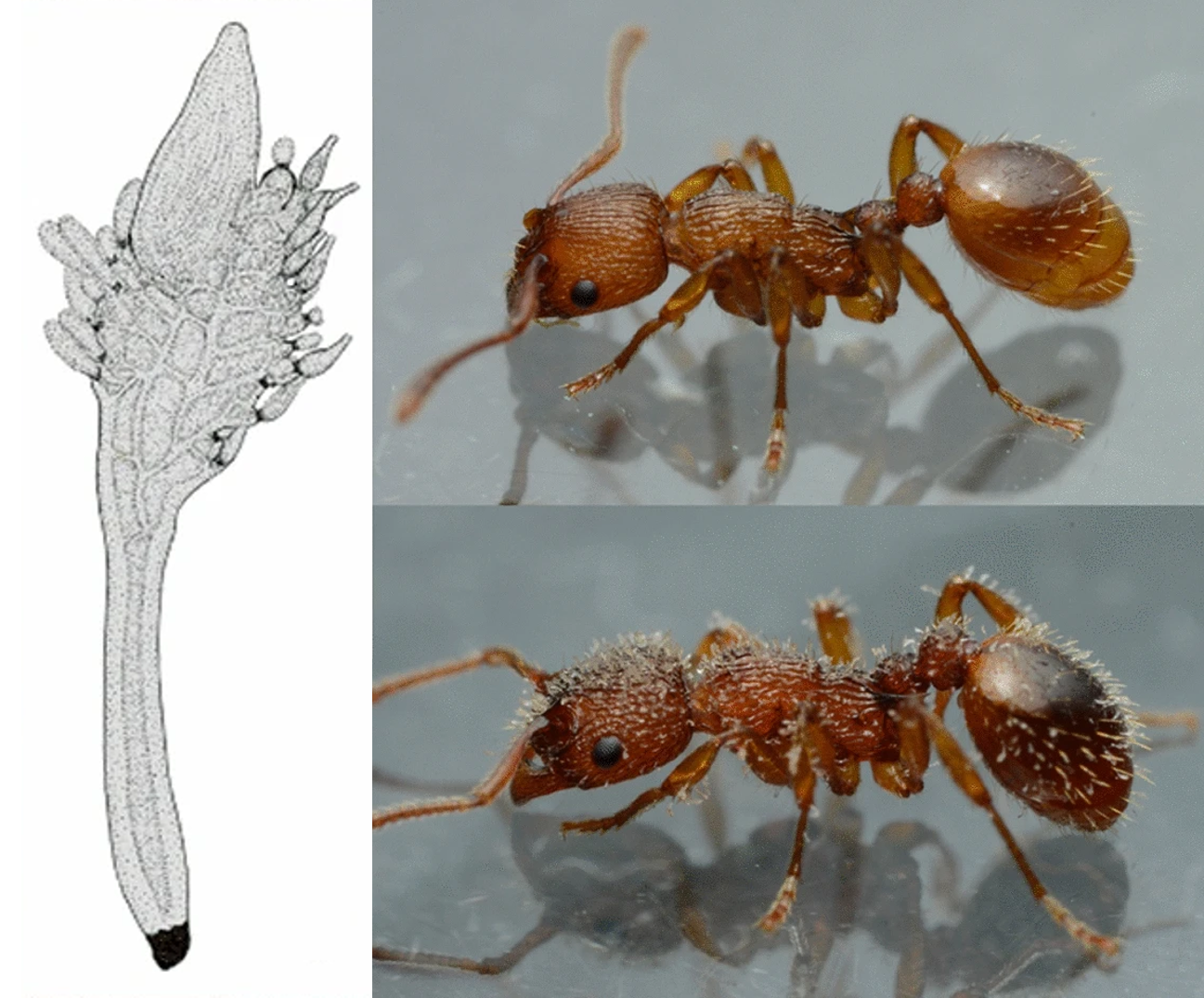
Rickia wasmannii is a fungus that lives on ants, and when it comes to ants and fungi most people usually think of Ophiocordyceps, i.e. the zombie ant fungus - which was the inspiration for The Last of Us series of video games and TV series. But R. wasmannii is not a killer - instead of zombifying its host and digesting the corpse, this fungus seems to reduce animosity and aggression between ants. First of all, let's take a look at what R. wasmannii actually does on ants. 

Left: Illustration of a Rickia wasmannii thallus, Right top: Uninfected ant, Right bottom: ant infected with R. wasmannii
Pictures from Figure 1 of this paper

Rickia wasmannii belongs to a group of fungi called Laboulbeniales, also known more colloquially as "labouls". These fungi have little holdfasts called haustoria that allows them to cling to the ant's cuticle. They are ectoparasites of insects that attach to their host's external surface and suck their hemolymph (insect's equivalent of blood). So in a way they are rather like ticks or lice (and yes, there are labouls that live on ectoparasitic insects, which one might consider as a bit of poetic justice).

But this fungus seems to do more than just suck the ant's blood, as it causes the infected ants and other ants around them to behave differently. Rickia wasmannii changes the host ant's cuticular hydrocarbon or CHC profile. CHC is essentially an ant's ID profile - they use it to recognise nestmates, tell each other apart, and be alerted to strangers from other nests. But R. wasmannii messes with that, scrambling the infected ants' CHC profile, and making them "smell" differently to uninfected ants.

Scientists wanted to find out how the presence of this fungus affects the way ants interact with each other. The challenge with studying ant behaviour is that when you put two ants together, it is difficult to tell apart whether the ant you are observing is responding to the other ant's chemical profile, or if it is responding to the way the other ant is reacting to them. The only way to get a clear observation is to present the ant with something that it would recognise as a fellow ant, but would not muddle the outcome by reacting to the ant that you are trying to observed

The solution turns out to be freeze-killed ants. Ants that are killed in this manner retain their CHC profile, so other ants would treat them just as another live ant, but obviously a dead ant wouldn't react to a live ant's presence and confound the outcome. In addition to those freeze-killed test subjects, scientists also made ant "dummies" which are essentially blank slates in ant forms that they can imbue with whatever chemical signature they were testing. These "dummies" were made by washing ant corpses in hexane to remove their chemical signature. To ants, these specially treated ant corpses are like faceless mannequin, with no identity - until the scientist imbues them with one, by anointing them with a droplet of cuticular extract from another ant.

When ants were presented with dummies that were smeared with the cuticular extract of ants from a different nest, the ants started biting, dragging, or stinging the dummies, much like how they would respond to a live ant from another nest. But when they were presented with either the corpse of a Rickia-infected ant, or dummies that "smell" like a Rickia-infected ant, they were more relaxed and less likely to get aggro. Furthermore, it's not just that the fungus made other ants act differently, the infected ant itself also starts behaving differently. Infected ants are generally less likely to pick a fight with another ant, but especially when facing other infected ants.

As mentioned previously, R. wasmannii seems to change the ant's CHC profile, but one would think scrambling the host ant's profile would make other ants react more aggressively towards them since ants usually have a "stranger danger" response to ants that "smell" different to their nestmates. But the way that R. wasmannii changes how an ant "smell" seems to have a calming effect, and this comes down to a molecule called n-C23 which is present in higher concentration on the cuticle of all infected ants. When the scientist presented ants with dummies that have been smeared with n-C23 and nothing else, almost all hints of aggressive behaviour ceased.

So by increasing n-C23 concentration in its host's cuticle, R. wasmannii has unlocked a life hack that allows it to not just access all areas in an ant colony, but to spread to other nests as well. In the scientists' study population, about half the colonies they studied had the fungus present, and in some nests, all the ants were infected with R. wasmannii. A testament to the fungus' successful manipulation of ant behaviour.

Furthermore the fungus' presence also affects another, very different parasite which also lives with ants - the caterpillar of blue butterflies. These caterpillars are social parasites that convince worker ants into adopting them into their nest. Once they are settled in, they start demanding food from the worker ants and even feed on the ant's developing broods. But the caterpillars don't seem to survive as long in nests which are already hosting R. wasmannii, and in the field, these two parasites co-occur less commonly than expected based on their respective prevalence, which indicates the caterpillar and the fungus are in competition over ant real estate.

By messing with their identity and making them more chilled out, R. wasmannii can turn an ant colony into a fungus party. But the consequences of that ripple out to other ant colonies too, along with the organisms that regularly take up residency in the homes of ants.

Reference:
Csata, E., Casacci, L. P., Ruther, J., Bernadou, A., Heinze, J., & Markó, B. (2023). Non-lethal fungal infection could reduce aggression towards strangers in ants. Communications Biology, 6: 183.

July 2, 2018

Dicroceolium dendriticum (revisited)

The lancet fluke (Dicroceolium dendriticum) is one of the most well-known and oft-cited example of parasite host manipulation. But in most people's mind, it often gets mixed up with the Cordyceps zombie ant fungus, which is understandable given that they both (1) manipulate an ant's behaviour, and (2) makes it climb onto vegetation. But that's where the similarities ends.

The lancet fluke and the zombie ant fungus are very different organisms, with very different plans for their ant host. First of all, the lancet fluke is a a type of parasitic flatworm which infects three different host animals throughout its life cycle - unlike the fungus which only infect the ant. And whereas the zombie ant fungus kills its host once it has reached the desire location to disperse its spore, the lancet fluke's endgame is to use ant as a way of reaching a mammal's belly, and it will make the ant repeat the climbing routine until that is accomplished.

Top: Internal structure of a lancet fluke-infected ant. Bottom: Internal structure of an (A) infected and (B) uninfected ant's head. Labels: emc (encysted metacercaria), nmc (nonencysted metacercaria), oe (), sog (suboesophageal ganglion)
Images from Figure 2 and 3 of the paper
In order to understand why lancet fluke does what it does to ants, let's look at its life cycle. The adult fluke lives in the bile duct of herbivorous hoofed mammals such as cattle, sheep, and deer. The adult fluke can produce hundreds or even thousands of eggs per day. These eggs are release into the outside world with the host's faeces, and some of them are swallowed by land snails.

The parasite turns the snail into a biological factory that churns a clone army of fluke larvae, which are packaged by the dozens into slime balls. These slime balls ooze out of the the snail's body, and are gobbled up by ants which find them to be an irresistible delicacy. Inside the ant, the parasite turns into what's known as a metacercaria and waits to be eaten by the final host. Given the final hosts of the lancet fluke are grazing mammals - none of which are particularly fond of eating ants - how is this parasite supposed to complete its life cycle? The lancet fluke solves this problem by making the infected ant climb onto and clamps itself to a bit of vegetation that such herbivores would eat, such as a blade of grass or a flower.

Unlike the zombie ant fungus where the ant stays locked in place and perishes once it has been moved into position, the lancet fluke will adjust the ant's behaviour depending on circumstances. If the surrounding temperature gets above 20ºC (68ºF), the parasite's spell wears off and the ant goes back to acting normal, since a hot sun-baked host is also bad for the parasites inside it. Once the temperature drops, the ant goes back to being in the parasite's thrall. While this striking example of host manipulation is well-known, exactly how the lancet fluke does that is a bit of a mystery.

The development of X-ray micro-computed-tomography, also known as microCT, has enable scientists to peer into the interior structure of many organisms, allowing them to, in a sense, perform a "virtual" dissection without inadvertently disrupting or displace the internal structures as a part of the dissection process. I've previously written a blog post about scientists who used microCT to visualise the root network of a body-snatcher barnacle, in this study another group of researchers applied the same technique to look at the lancet fluke in its ant hosts.

The researchers collected some ants from Cypress Hill Interprovincial Park in Canada, at a site which is known to be home to the lancet fluke. When the looked at the internal structure of the infected ants using microCT, they found that the parasites distribute themselves throughout the ant's body in a very specific way. When an ant eats a slime ball, it swallows a batch of genetically identical parasite clones, most of which will take up resident in the ant's gaster (its abdomen) and become "encysted" - curled up and wrapped in a protective membrane. But no matter how many lancet flukes the ant ends up with, there is always one unencysted larva which is embedded in the ant's head - specifically underneath its suboesophageal ganglion (SOG).

The SOG can be considered the cockpit of an ant - it is a control hub responsible for regulating the ant's behavioural patterns. Unlike its clonal sibs which are wrapped up in a cyst and walled off from the outside, this "head fluke" can continue to interact with and push the ant's neurological buttons from the SOG. Exactly what kind of physiological exchange is taking place between the parasite and the ant's brain has not been determined at this point, but it seems pretty clear that this "head fluke" plays an important role.

But being able to control the host come at a significant cost for the fluke. Unlike its clone mates which are enclosed in a protective coat, the "head fluke" has to sit naked and exposed because it needs to interact with the ant's brain. The cyst wall is what allows larval lancet flukes to survive passing through the final host's digestive system, and the exposed unencysted manipulator parasite will not survive this journey. So in order to bring an ant to a grazing mammal, one little lancet fluke sacrifices itself so that its clone mates will have a prosperous and productive future.

Reference:
Martín-Vega, D., Garbout, A., Ahmed, F., Wicklein, M., Goater, C. P., Colwell, D. D., & Hall, M. J. (2018). 3D virtual histology at the host/parasite interface: visualisation of the master manipulator, Dicrocoelium dendriticum, in the brain of its ant host. Scientific Reports 8(1): 8587.

January 29, 2017

Ophiocordyceps pseudolloydii

The Cordyceps fungus has become a fixture in popular media, at least as the go-to comparison/cause for fictional human zombies. The nominal Cordyceps that most people think of is probably Ophiocordyceps unilateralis - the infamous "zombie ant fungus". But what most people don't realise is that there isn't just "the Cordyceps fungus" - that is just a single species out of many ant-infecting fungi in the Ophiocordyceps genus. That's right - there are multiple species of zombie ant fungi and they are all different. Each of them have evolved their own ways of getting the most out of their ant hosts.

Photo of infected ants from Fig. 1 and Fig. 2 of this paper
The species featured in today's blog post is Ophiocrodyceps pseudolloydii, and it is found in central Taiwan. This fungus specifically targets a tiny ant called Dolichoderus thoracicus. In the forest of central Taiwan are so-called "ant graveyards" - areas with high density of Cordyceps-infected zombie ants. Such sights are familiar to scientists who study these ant-fungi relationships, indeed, such "ant graveyards" have been found in other parts of the world where ants and Cordyceps fungi co-occur.

A group of scientists set out to document the behaviour and position of ants which have been mummified by O. pseudolloydii. One key thing they observed was that no matter where the zombie ants were found in the forest, the head of the dead ant tends to be pointed towards the direction of openings in the forest canopy. This indicates that the fungus might be using sunlight that comes through the canopy as a cue to steer the host ants into position.

Like other ant-infected Cordyceps fungi, O. pseudolloydii places the host ant in a position which is ideal for spreading its spores, without being dried out in open air. This usually means placing the ant underneath a leaf. But the fungus needs some way of anchoring the ant to the leaf before it can mummify the host and start sprouting into a fruiting body. Ophiocordyceps unilateralis induces a "death grip" in the zombified ants, whereby the ant locks its mandible around the vein of a leaf to secure it in place.

But O. pseudolloydii does not do that - instead of using the ant's mandible, O. pseudolloydii simply sprout a dense mass of fungal tissue which binds the ant to the underside of a leaf. So why doesn't it simply do what its more famous cousin does and make the ant bite down on a leaf vein? Possibly because the ant which O. pseudolloydii infects is much smaller than the carpenter ant which O. unilateralis parasitises. Compared with the carpenter ant workers which can grow up to 25 millimetres (about an inch) in length, the workers of D. thoracicus are merely 4 millimetres long. With such a tiny host a dense mat of fungal tissue is enough to anchor the ant in place.

By doing so, this might allow the fungus to save on making the mind-altering chemical to induce the leaf-vein biting behaviour, which can possibly allow it to produce more spores instead. All Ophiocordyceps pseudolloydii needs to do is make sure the ant is intoxicated enough to crawl to the right spot, and once that is done, the fungus will take care of the rest.

Reference:
Chung, T. Y., Sun, P. F., Kuo, J. I., Lee, Y. I., Lin, C. C., & Chou, J. Y. (2017). Zombie ant heads are oriented relative to solar cues. Fungal Ecology 25: 22-28.

November 6, 2016

Macrodinychus multispinosus

There are variety of mites which live with ants, but many of them are not well-studied. Most of them are either phoretic mites which hitch a ride on the ant's body, or detritivores that eat various substances which can be found in ant nests and in those cases, they are relatively harmless commensals. But some mites that live with ants are ectoparasites. The study being featured today is about a mite that lives (and feeds) on ants - Macrodinychus multispinosus. There are variety of other mites that also feed on ant haemolymph (a fluid which is the equivalent of blood in insects), but this vampire takes it to an another level.
Left: Ant pupa host being progressively eaten alive by the parasitoid mite.
Right (top): Adult female and male Macrodinychus multispinosus mites
Right (bottom): A M. multispinosus nymph at the stage when it is attached to the host (note the stumpy legs)
Photos from Figure 1, 3, and 5 of the paper. 
Newly hatched M. multispinosus nymphs are born with fairly long limbs which allows them to move about and find a host, but once they are attached to an ant pupa, their limbs are reduced to stumps. The mite essentially become a tiny biological pump. And whereas other blood-sucking mites that feed on insects are content with imbibing just some of the host's life blood, M. multispinosus does not hold back - it consumes all the developing ant pupa's internal tissue and literally sucks the life out of it.

Macrodinychus multispinosus can be considered as a parasitoid - even though its modus operandi is very different to parasitoid wasp which devour their host alive from the inside and burst out xenomorph-style once they are ready to pupate, the outcome is pretty much the same - a dead, empty host. The researchers behind the paper being featured in this post conducted their study at Quintana Roo, Mexico across a number of field sites where they inspected colonies of the longhorn crazy ant
(Paratrechina longicornis) - the mite's only known host.

They found this vampire mite to be relatively common - of the seventeen colonies they sampled, eight of them were infested with M. multispinosus. Overall, about a quarter (26.2%) of the ant pupae they examined were infected with these mites. In some nests, over three-quarters of all the pupae are parasitised. They noticed that M. multispinosus definitely seems to have a preference for the worker ant pupae and developing queens are usually spared. Even though by doing so, this vampire wouldn't end up killing off potential future colonies by parasitising the reproductive members of the colony, it is still killing off the developing workers and this can be quite harmful at a colony level if the mites are present in high numbers.

It seems that M. multispinosus has settled quite well into its niche as a ectoparasitoid of the longhorn crazy ant, and like other mites in the Macrodinychus genus, it is rather specific about where it attach to the host - in this case the ant pupa's abdomen. But here's the twist - whereas M. multispinosus is native to Quintana Roo, its host is not and is a relatively recent arrival to the region. Even though this vampire mite must have been parasitising ants long before the longhorn crazy ant came along, its original host is still unknown to science - in fact, even though it was described in 1973, it wasn't until now that its ecology and life cycle has been documented.

There's still a lot to learn about this little vampire. Would it be a good biological control for the invasive longhorn crazy ant? What kind of ant did M. multispinosus originally parasitised before it jumped on the invader? How was it able to take to the newly arrived host so quickly?

With so many different kinds of organisms being transported (purposefully or inadvertently) around the world, perhaps is would be useful to consider recruiting parasites are as a mean of controlling invasive species, especially if the parasite is native to the region where biological control is being considered - that way, it'll be fighting on its home turf.

Reference:
Lachaud, J. P., Klompen, H., & Pérez-Lachaud, G. (2016). Macrodinychus mites as parasitoids of invasive ants: an overlooked parasitic association. Scientific Reports 6: 29995

P.S. If you like this post and other posts like it on the blog, then you might been interested in checking out the book "The Wasp that Brainwashed the Caterpillar" by Matt Simon. It is full of funny and informative stories about wonderfully weird and bizarre animals both parasitic and non-parasitic - you should totally check it out!

December 10, 2015

Anomotaenia brevis

There are many examples of parasites altering the behaviour of their hosts, and some of them turn their hosts into functionally different animals compared with their uninfected counterparts. When this occurs in highly social animals, this effects can cascade onto other members of the group. Anomotaenia brevis is a tapeworm which happens to be one of many parasite species which have been documented to modify their host's appearance and/or behaviour in some way.
Photo by Sara Beros, used with permission

While the adult tapeworm lives a pretty ordinary life in the gut of a woodpecker, the larva uses a worker ant as a place to grow and a vehicle to reach the bird host. Specifically, they infect Temnothorax nylanderi - a species of ant found in oak forests of western Europe. These ants nest in naturally occurring cavities in trees such as sticks or acorns and the colony consists of a single ant queen surrounded by several dozen worker ants. These ants are a regular part of the woodpecker's diet so there's a fairly reasonable chance that the tapeworm will reach its final destination if it waited around for long enough. But A. brevis is not content with just leaving it to chance.

Worker ants can become infected through eating bird faeces which are contaminated with the parasite's eggs. As the tapeworm larvae grow inside the ant's body, these infected worker ants become noticeably different from their uninfected counterpart; they smell different (determined by the layer of hydrocarbon chemicals on their cuticle), they're smaller, they have yellow (instead of brown) cuticles, spend most of their time sitting around in the nest, and for some reason their uninfected nestmates are more willing to dote on these tapeworm-infected ants rather than healthy ones. They essentially become a different animal to the healthy workers, and other ant parasites have been known to alter their host to such a degree that parasitised individuals were initially mistaken as belonging to an entirely different species.

When scientists investigated the prevalence of A. brevis in nature, they found that about thirty percent of the ant colonies they came across have at least some infected workers. While in some nests only a few of the workers are infected, in other cases over half the workers are carrying tapeworms. Furthermore, they also found a few of the workers (2%) were infected but had yet to manifest the symptoms associated A. brevis. When over half the work force of a colony is under the spell of a body-snatching parasite, that must affect the colony in some way. So how does this affect the ant colony as a whole?

During their development, infected ants have higher survival rate and far more of them (97.2%) reach adulthood compared with uninfected (56.3-69.5%) ants. This make sense from the perspective of the parasite's transmission as it needs its host to stay alive for as long as possible to get inside a woodpecker. But it seems to also affected their uninfected sisters because uninfected worker ants in a colony which has parasitised workers also have lower survival rates than those from colonies free of any tapeworm-infected ants. But A. brevis also affects the colony's functioning in other ways as well.

The scientists behind the paper being featured today conducted a series of experiments where they manipulated the composition (and in doing so, parasite prevalence) of experimental ant colonies. Since T. nylanderi colonies regularly experience take-over and/or merging with other colonies, introducing or remove new ants into the experimental colonies would not cause them to exhibit unnatural behaviours as it is not too different what would usually occur in nature anyway. They set up colonies with different proportion of A. brevis-infected workers and tested how they responded to different types of disturbances.

They simulated a woodpecker attack by cracking open the experimental ant nests and seeing how long it took for them to evacuate. Under a simulated attack, about half of the healthy worker escaped (48-58.9%) but very few of the tapeworm-infected workers escaped (3.2%), which is exactly what the tapeworm wants - remember, the parasite needs to be eaten by a woodpecker to complete its lifecycle - so when one comes knocking, the tapeworm gets it host to sit tight and prepared to be sacrificed.

They also simulated intrusion from ants of a different colony or species by pitting individual invading ants against their experimental colonies. These invaders consisted of a mix of infected and uninfected individuals from nests which contained some or no infected nestmates. When confronting ants from other colonies, they were the most aggressive against the intruder if it was of a different species (in this case, T. affinis), but when it comes to other T. nylanderi ants, they responded more aggressively if the intruder from a different colony was harbouring tapeworm larvae.

In contrast, they were pretty chill about the presence of tapeworm-infected ants if it was one of their own nestmate. But the tapeworm also affected colony aggression in another way - the research team noted that colonies with many infected workers were also less aggressive overall towards any invaders. Not only does A. brevis alter its host's appearance and behaviour, it also seem to cause the host's nestmates to be more chilled out.

Parasites can manipulate their host in some astonishing ways, and the host's altered behaviour and/or appearance has been described as the parasite's "extended phenotype". But when the host is a social animal that is surrounded by many other group members, the parasite's influences can extend well beyond the body of its immediate host, and manifest in the surrounding kins and cohorts as well.

Reference:
Beros, S., Jongepier, E., Hagemeier, F., & Foitzik, S. (2015). The parasite's long arm: a tapeworm parasite induces behavioural changes in uninfected group members of its social host. Proceedings of the Royal Society B 282: 20151473

August 11, 2014

Apocephalus attophilus

This is the third post in a series of blog posts written by students from my third year Evolutionary Parasitology unit (ZOOL329/529) class of 2014. This particular post was written by Jon Schlenert on a paper published in 1990 about a way that leaf-cutter ants defend themselves against parasitoid flies (you can read the previous post about a tardigrade-killing fungus here).

Photo by Norbert Potensky
Leaf cutter ants are well known for their important ecological role as herbivores of tropical forests. The ants harvest large quantities of leaf material which they use as garden beds to grow a highly specialised, symbiotic fungus which is eaten by the ants. Less well known is that leaf cutter ants exhibit a peculiar behaviour  whereby smaller ants of the same species called minims, hitchhike on the leaves being carried back to the colony by the larger foraging ants.

Observations of this hitchhiking behaviour provoked much speculation about its purpose, and two alternative hypotheses arose to explain it. The first hypothesis, dubbed the energy conservation hypothesis, suggested that the smaller ants undertook important roles at the foraging site, and would then hitchhike back to the colony on the leaves to reduce energy costs. The second hypothesis, the ant protection hypothesis, posited that hitchhiking behaviour was a defensive response to pressures from parasitic flies.

The flies belong to the family Phoridae and mostly parasitise hymenopterans: ants, bees wasps. The reproductive strategy of parasitic phorids involves the female laying eggs inside the bodies of living insects. The parasitised insects are kept alive whilst the larvae hatch from the egg and begin to consume the host’s tissue. Eventually the larva is ready to leave the host and become a free living adult, when it emerges the host is left mortally wounded or in some cases is already dead beforehand.

Leaf cutter ants have their share of parasitic flies. Foragers are particularly vulnerable to attacks from the flies as they are unable to defend themselves whilst carrying leaves back to the colony. A female fly will land on the leaf fragment being carried, and make its way down towards the joint between the cephalon (head) and cephalothorax (first thoracic segment) of the ant. The fly, using it’s long ovipositor, injects an egg between the armoured plates and quickly absconds.

In the paper, researchers set out to quantitatively assess whether the hitchhiking behaviour in leaf cutting ants is a response to attack from parasitic flies. Research was carried out on Barro Colarado Island in Panama; an important research location for studying tropical ecosystems. The two species looked at were the ant species Atta colombica and its parasitic fly Apocephalus attophilus. The study found strong evidence in favour of the ant protection hypothesis and concluded that hitchhiking behaviour is driven by parasitism rather than energy conservation. The study also found that flies require leaf fragments to stand on whilst they inject their eggs, thus only leaf carriers were susceptible to parasite attack. The presence of hitchhikers significantly reduced the probability of attack from the flies and represents a major investment into parasite defence. Furthermore, the researchers observed that the ants were able to adjust the level of hitchhiking behaviour displayed in response to daily and seasonal changes in parasite abundance.

The highly specialised defensive response of leaf cutter ants represents a significant cost to the colony, as ants are diverted from undertaking other important tasks. Consequently, there is a trade-off between investing in parasite defence or other areas such as caring for offspring. This demonstrates that parasitism from phorids has shaped the evolutionary responses of leaf cutter ants, and is a strong influence on their ecology and behaviour.

Reference
Feener Jr, D. H., & Moss, K. A. (1990). Defence against parasites by hitchhikers in leaf-cutting ants: a quantitative assessment. Behavioral Ecology and Sociobiology 26:17-29.

This post was written by Jon Schlenert

April 20, 2014

Controrchis sp.

Extreme weather events can cause significant changes to ecosystems and their inhabitants. When Hurricane Iris made landfall at Belize, it caused widespread devastation in its wake. The study we are featuring today was a part of a larger project to look at how Hurricane Iris affected a population of black howler monkeys (Alouatta pigra) which has been monitored since 1998. In the aftermath of the hurricane, the number of monkeys in the forest decreased by 78 percent until their population began to stablise and increase three and a half years later. But aside from such outwardly visible impacts, there were also other changes afoot within the monkeys themselves.
Photo of black howler monkey by Ian Morton

A team of scientists interested in monitoring the recovery carried out a study to see how this has affected the monkeys' parasites. It is possible that these primates are harbouring higher parasite loads than they did before the hurricane due to the stress of living in a disturbed habitat. The scientists collected samples of monkey fece over the course of 3 years and look for parasite eggs. They also measured the level of cortisol, a hormone associated with stress, present in the fecal sample, and collected data on other aspects of the monkey's behaviour to see if they were associated with their parasite burden.

Photo of Controrchis eggs
from here
The black howler monkeys were found to have five species of roundworms and a species of digenean fluke (based on the presence of their eggs in the monkey poop), but the prevalence and abundance of those parasites were not associated with the level of stress hormones. Instead, nematode (roundworms) prevalence was heavily dependent on population density and the size of the groups in which the monkeys gathered. This is to be expected as these worms are transmitted via accidental ingestion of eggs or larvae from the host's feces. The more monkeys there are around in a given area, the more opportunities for these particular parasites to be passed on. This is similar to what has previously found in other studies on primate parasites. But the only factor that successfully predicted the occurrence of the digenean trematode fluke Controrchis was the amount of leaves the monkeys consumed.

While black howler monkeys usually prefer a diet filled with fruit, in the aftermath of Hurricane Iris there were no fruit-bearing plants in the forest for 18 months. So the monkeys were forced to go on a leaf-based diet instead of the fruit-based one they enjoyed before the hurricane, and the plant most readily available and palatable to the monkeys was Cecropia. These fast-growing leafy plants usually happens to be the first on the scene in the wake of such habitat disturbances. They do not contain as much fibre as other plants and have little in the way of noxious defensive chemicals - which makes Cecropia excellent fodder for the black howler monkeys. Cecropia also contains a lot of what these monkeys need in a balanced diet, so in the absence of fruits, the howler monkeys munched readily on these nutritious greens

But why is the consumption of Cecropia associated with the prevalence of Controrchis? The fluke does not use leaves and vegetation as a mean of transmission (unlike Fasciola the liver fluke), instead, Controrchis uses ants as a go-between to get in their vertebrate host. But these monkeys don't really have a taste for ants, so why is Controrchis prevalence linked to the amount of leaves they have consumed? That is because Cecropia also happens to be myrmecophtyes, or ant-plants. Monkeys that are chowing down those leafy greens are also inadvertently swallowing a lot of ants, which means taking onboard a lot of Controrchis waiting to make a connection with a suitable monkey host.

For another more detailed take on this paper, from the lead author herself, see this post here

Reference:
Behie, A. M., Kutz, S., & Pavelka, M. S. (2014). Cascading Effects of Climate Change: Do Hurricane‐damaged Forests Increase Risk of Exposure to Parasites?. Biotropica 46: 25-31.

November 12, 2013

Ophiocordyceps sessilis

There are many species of fungi that infect insects and some of the most well-known species are the ones that infect ants, better known to most as the "zombie ant fungus". We have previously featured one such fungus and its ant-jacking antics on this blog. But while most people might think that there's just a single zombie ant fungus out there which is responsible for creating this intriguing wonder (or nightmare) of nature, there are actually many different species of such fungi and they are found all over the world infecting various different insects. In the Ophiocordyceps genus alone there are over a hundred species and there might be some undescribed fungi that are hiding in plain sight because they have been misidentified and misclassified as a previously known species.
Photo of Ophiocordyceps sessilis from
Fig. 1 of the paper

Today, we are going to be featuring one such fungus and it hails from Japan where they are called Kobugata-aritake which means the "bump-neck ant fungus". The fungi specimen described in the paper we are discussing today were originally collected in 2006 from a forest near the village of Iitate, Fukushima. They were initially thought to be specimen of a fairly commonly found species call Ophiocordyceps pulvinata, but upon reexamination, researchers noticed a number of key differences which separated O. sessilis from O. pulvinata.

Both fungi were found sprouting from dead ants which had their mandibles clamped tightly around a branch in the typical "zombie ant" pose, but whereas O. pulvinata produce a bulbous fruiting body that sprouts from the back of the ant's head (see photo on lower left), ants infected with O sessilis are covered in spiny fruiting bodies jutting out all over the ant's body (see photo on upper right).

Further difference between the two fungi can be seen under the microscope; O. pulvinata produce discrete spores that are long and slim, but the spores of O. sessilis look like beads on a necklace which readily breaks apart into small "part-spores". These part-spores of O. sessilis can also germinate on malt-extract agar plates within two days, growing into soft, velvety colonies of fungal mass, whereas O. pulvinata spores failed to grow on such artificial medium. Finally, comparisons of sequences from selected genetic markers revealed that O. sessilis is clearly a very different species to O. pulvinata.

Photo of Ophiocordyceps pulvinata from
Fig. 1 of the paper
A peculiar thing the researchers noticed is that O. sessilis is only ever found in ants that are also infected with O. pulvinata. They suggested that O. sessilis is actually a parasite of O. pulvinata itself and noted other Ophiocordyceps species are often found in pairs, so what had previously be considered as coinfections may in fact be a case of hyperparasitism (whereby a parasite is itself infected by a parasite).

However, there is another possibility that the researchers did not mention in their paper, which was that O. sessilis needs O. pulvinata to pave the way in order for them to colonise the ant's body. An example of this is can be found among fluke-snail host-parasite systems. Like most digenean trematodes, the blood fluke Austrobilharzia terrigalensis they needs to infect a snail for the asexual part of its life cycle, but unlike those other species, A. terrigalensis cannot infect a snail on its own and is always found in snails that are already infected with another species of fluke. The coinfecting species always appear shriveled and emaciated in the presence of A. terrigalensis and it has been suggested that while A. terrigalensis lacks the ability to subvert or suppress the immune defences of snails, they are capable of colonising a snail once its defences have been knocked out by another species, at which point they barge in, overpower the resident parasite and take over the host.

So either O. sessillis is a hyperparasite (or a "mycoparasite" - a parasite of a fungus) of O. pulvinata, or it cannot colonise a host on its own and instead piggybacks on O. pulvinata, eventually usurping it and taking over the ant for its own. Either way, it appears that O. sessilis is a fungus that can hijack a fungus which is used to hijacking ants.

Reference:
Kaitsu, Y., Shimizu, K., Tanaka, E., Shimano, S., Uchiyama, S., Tanaka, C., & Kinjo, N. (2013). Ophiocordyceps sessilis sp. nov., a new species of Ophiocordyceps on Camponotus ants in Japan. Mycological Progress 12: 755-761.

P.S. I recently wrote an article for The Conversation about parasites that can survive freezing - including the hairworm (otherwise known as the parasite that gives crickets nightmares). To read it, just follow this link here.

November 22, 2011

Ophiocordyceps unilateralis


Have you ever been so intoxicated that you start walking erratically, stumble away from your friends, stagger around in circles, clamber onto things that you wouldn't normally be seen near, and the next thing you know, you are strapped down in unfamiliar surroundings, unable to extricate yourself? Well, that pretty much describe what happens to ants which become infected with the famous "zombie ant" fungus - Ophiocordyceps unilateralis.

Much has been written about this famous fungus which turns ants into zombies - it is a parasite which captures the same part of our psyche as the monstrosities of horror movies, and there is evidence to suggest that these fungi have been tormenting ants for at least tens of millions of years. But despite all that attention, few people have actually witnessed or documented the sequence of behaviour leading up to the infected ant's paralysis and death. But in a paper published this year, a group of researchers followed the behaviour of ants infected with the famous "zombie"-inducing fungus and compare them to their uninfected brethren.

They noticed a few peculiarities with the behavioural repertoire of infected ants which stood out. While healthy ants studiously stick to the usual lanes of ant traffic, climbing into the canopy to forage with all the other busy worker ants, "zombie ants" are loners which meander around in the understory by themselves, are unresponsive to most stimuli, and frequently stumble and fall from the branches they are walking on. Essentially, the ants act absolutely drunk, indeed, the researchers described the behaviour of the "zombie ants" as a "drunkard's walk" in their paper. Another weird thing that infected ants start doing is their tendency to crawl all over and bite into leaves - something which healthy ants don't tend to do. There's a good reason why the fungus steers the ant towards leaves and afflict it with this oral fixation - it is preparing it for the next step in the fungus' development.

For the fungus to successfully reproduce, the ant must die - but it must die in a particular position to maximise the viability and dispersal of the fungal spores, specifically in the humid understory, hanging from the underside of a leaf, about 25 cm (about 10 inches) above the ground. But once the fungus maneuver the ant into position, how does it get the host to comply and stay there? The researchers made fine histological cross-section of the infected ant's head and found that once the fungus has made the ant locks its mandible in place, it busily gets to work dissolving the muscles which control those mandibles, ensuring that the ant will be locked in a death grip forevermore. A few days after the ant dies while gripping onto, the fungal stalk emerges from the head of the ant, ready to spray its spores down to the soil below to create more drunken "zombie ants".

Image from the Wikipedia.


Postscript: A few hours after I wrote this post, I found out that Carl Zimmer has already written about this study (why, of course! *facepalm*), so if you want to read his version instead, you can see it here.

August 30, 2011

Skrjabinoptera phrynosoma

Life isn't easy as a parasite with a complex life-cycle. In order to grow up and reproduce, you often need to make your way through the bodies of at least two very different host animals - a very haphazard process that depends largely on timing and luck. In the case of today's parasite - a nematode worm called Skrjabinoptera phrynosoma - it has to make its way between a lizard and an ant. The adult S. phrynosoma lives inside the stomach of the desert horned lizard Phrynosoma platyrhinos. However, when the female becomes filled with mature eggs, she migrates to the lizard's cloaca (a nice, technical way of describing a lizard's butt).

Unlike most parasitic nematodes, which often lay eggs that are cast out of their host and left exposed to the elements, S. phrynosoma is a very maternal parasite - in a slightly morbid way. The female S. phrynosoma makes the ultimate sacrifice by casting her egg-filled body out of the lizard via the host's feces. She will die outside of the host - but in addition to protecting her eggs by doing so, it is also her strategy for helping her eggs reach the next host. For some reason, ants find the shriveled, egg-filled cadavers of female S. phrynosoma to be a tasty treat, a meal fit to feed to their brood of growing ant larvae - which then become infected with the parasite's own larvae. The life-cycle is complete when the infected larvae mature into workers, emerge from the colony, and become lizard food - horned lizards are specialists on ants.

Researchers at Georgia Southern University discovered that to ensure that this sequence of events occurs, S. phrynosoma has evolved to synchronise its life-cycle with the seasonal behaviour of both its lizard and ant hosts. They found that the number of egg-filled females (all ready to evacuate) reach peak abundance during the middle of the lizard's mating season. This is also the period when there are the greatest number of ants out busily foraging and when the colonies are packed to capacity with broods of growing ant larvae. By timing its life-cycle in such a manner, S. phrynosoma ensures that when next season rolls around, when those broods of larvae are ready to emerge as a new generation of workers ants, they will be doing so pre-infected with nematodes and just in time to welcome the hungry lizards coming out of hibernation.

Reference:
Hilsing, K.C., Anderson, R.A. and Nayduch, D. (2011) Seasonal dynamics of Skrjabinoptera phrynosoma (Nematoda) infection in horned lizards from the Alvord Basin: temporal components of a unique life-cycle. Journal of Parasitology 97: 559-564.

January 30, 2011

Allomermis solenopsi

It seems that ants just can't get a break when it comes to parasites. When they are not being persuaded to clamp themsleves to the top of a grass blade for a nightly sacrificial ritual (Dicrocoelium dendriticum), they are doing impersonations of a juicy berry thanks to some worms in their gut (Myrmeconema neotropicum). Today's parasite adds to the insult and takes its ant host for an impromptu swim, then leaves it to drown. Allomermis solenopsi is a nematode from the Mermithidae family, a group of nematodes which have plagued insects for at least 40 million years. While they superficially resemble nematomorph hairworm (e.g. Spinochordodes tellinii) and have a similar life-cycle, these worms actually belong in a separate phylum. However, the mermithid nematodes have convergently evolved the same ability as the hairworms to manipulate their hosts - namely, taking the host for a suicidal trip to the pool. Allomermis solenopsis develops inside the gaster (abdomen) of the ant and when it reaches maturity, it needs to exit into a body of water to mate and lay eggs. Other species of mermithids are well-known for inducing water-seeking behaviour in their hosts, so given that the nematode would dry out very quickly if it becomes exposed to the outside environment, it is likely that when the time comes, A. solenopsi just takes its ant for a terminal dunk.

Image from figure of the paper.

Reference:
Poinar Jr, G.O., Porter, S.D., Tang, S. and Hyman, B.C. (2007) Allomermis solenopsi n. sp. (Nematoda: Mermithidae) parasitising the fire ant Solenopsis invicta Buren (Hymenoptera: Formicidae) in Argentina. Systematic Parasitology 68: 115-128.

Contributed by Tommy Leung.

August 10, 2010

August 10 - Dicrocoelium dendriticum

Dicrocoelium dendriticum, better known as the lancet fluke, is a species of fluke that lives in the liver of grazing mammals such as sheep. Like most flukes, it has a 3 host life-cycle, the adult worm living inside the sheep, lay eggs which are shed into the environment with the sheep's faeces. The first intermediate host for this parasite are terrestrial snails which become infected by accidentally ingesting the parasite's eggs. The parasite undergoes clonal replication inside the snail, producing hundreds of infective larvae which are then packaged into slime balls and extruded into the environment. For some reason, these slimeballs are eagerly gobbled up by ants which are the parasite's second intermediate host.

Now sheep are not known for including ants as a significant part of their diet, so how is D. dendriticum supposed to get itself into a sheep through an ant? It does that by taking control and setting its ant host up for a rendezvous every evening. Once infected, the ant begins to behave very oddly indeed. As dusk falls, it would crawl up a blade of grass until it reaches the tip, then firmly clamps itself into that position with its mandible for the entire evening. The infected ant would perform this peculiar routine every night, but as the sun rises, it would resume its usual activities - assuming that it has survived the evening and not been incidentally ingested by a hungry sheep. By inducing this peculiar behavioural pattern in the ant host, D. dendriticum brings itself (through the ant) within the vicinity of a grazing sheep, thus setting up an encounter which otherwise would not have occurred, allowing it to complete its seemingly obtruse life-cycle.

Check out the very funny cartoon version of this life cycle here.

Contributed by Tommy Leung and thanks to Craig Carlough (Lancaster, PA) for sending along the Oatmeal comic.

July 11, 2010

July 11 - Anergates atratulus


Over on Dechronization, a blog I used to be involved with, Liam Revell posted a very cool video of an ant war going on in his yard. Alex Wild, who writes at Myrmecos, informed Liam and all that the ants were two colonies of pavement ants - Tetramorium - battling over territory. I thought that was pretty darn cool (and of course was just picturing tiny chitinous "Braveheart" scenes), but there's an added level of coolness. Anergates atratulus is a species of ant that is an obligate parasite on Tetramorium, in that A. atratulus does not produce its own workers. Entomologists have never found this species with a fertile Tetramorium queen, thus this parasitic species has to figure out a way to squeeze out its reproduction in a limited time span.

Photo from this site.

February 27, 2010

February 27 - Myrmeconema neotropicum


Yesterday, the parasite was saving coffee berries, today the parasite is making ants look like berries. Myrmeconema neotropicum is another nematode parasite that infects the ant, Cephalotes atratus in South America. The life cycle is somewhat similar to that of yesterday's parasite. Foraging ants pick up the nematode's eggs which have been shed in bird feces and feed them to their larvae. Inside the ant pupa, the worms hatch, mature and mate. As the embryos inside the female nematode mature, the gaster, or abdomen of the ant, swells and goes from being black, to translucent, to bright red. Adult ants then walk around with bright red abdomens held up into the air and are also slower and "clumsier" - perfect targets for frugivorous birds. The species, described in 2008, also changed the taxonomy of the ant hosts. Over a century before, a variety of tropical ants had been described based on their unusual red abdomens. We now know that they were just parasitized individuals. Makes me wonder how many other "species" have been erected based on parasite-induced morphological changes...

Image from figure of the paper.

You can read the original paper here.